
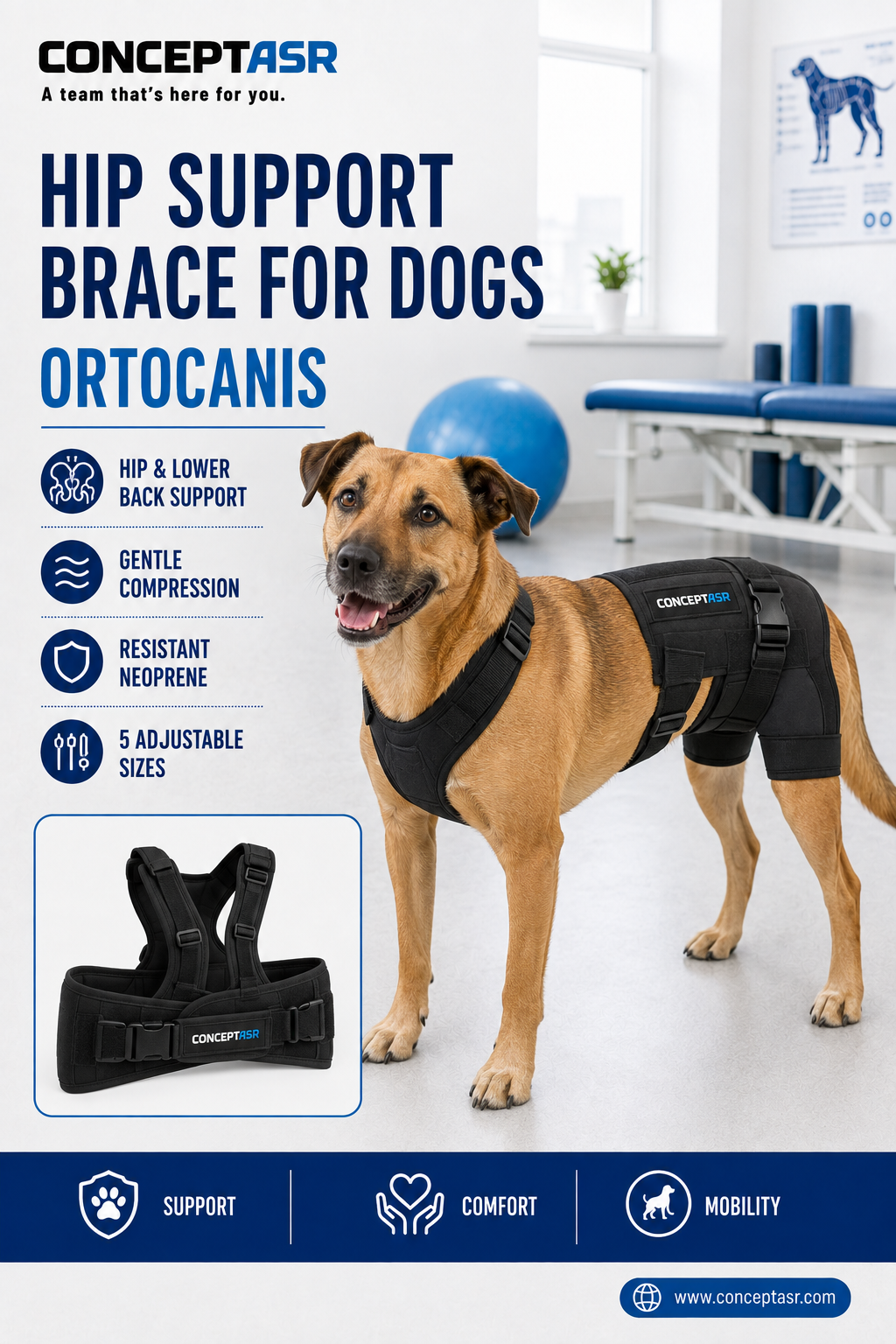
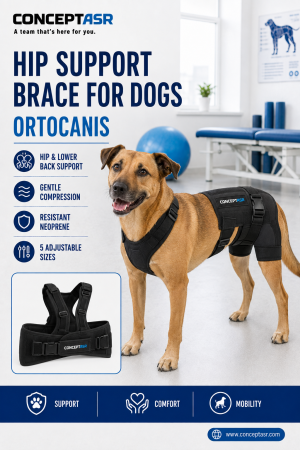
A hip support brace for dogs provides warmth, gentle compression and physical support around the hips and lower back. The Ortocanis brace is designed for active, recovering or senior dogs that may benefit from additional support during supervised daily activities.
Made from resistant neoprene, the brace wraps around the dog’s hip area and connects to a chest anchoring section to help maintain its position.
Hip Support Brace for Dogs
The Ortocanis hip support brace for dogs may be considered for animals experiencing mild to moderate hip dysplasia, arthritis, reduced endurance or weakness affecting the hips and lower back.
It may also be incorporated into a professionally supervised recovery program following certain injuries or surgical procedures.
The brace does not immobilize the hip joint. Instead, it provides warmth, light compression and external support around the hip and lower-back muscles.
Veterinary assessment is recommended before use because hip discomfort, weakness and limping can have several different causes.
Common Indications
The Ortocanis hip brace may be considered for dogs experiencing:
• Mild to moderate hip dysplasia
• Arthritis or osteoarthritis affecting the hips
• Reduced endurance during physical activity
• Hip sensitivity or discomfort
• Lower-back weakness
• Fatigue or limping in the rear legs
• Recovery following certain injuries
• Postoperative support when recommended professionally
• Age-related difficulty with movement
This product is not recommended for dogs with degenerative myelopathy. Ask your veterinarian to identify the cause of the dog’s mobility difficulties before ordering.
Resistant Neoprene Construction
The brace is manufactured from resistant neoprene selected for its flexibility, warmth and ability to provide gentle compression.
Its adjustable configuration helps position the supportive section over the hips and lower back while the front harness anchors the brace around the chest.
The brace should fit securely without restricting breathing, normal leg movement or circulation.
Inspect the skin and coat beneath the brace regularly. Remove the product immediately if you observe persistent redness, pressure marks, swelling, overheating or unusual discomfort.
Important Product Limitation
The hip support brace is not designed to prevent the dog’s rear legs from spreading apart.
Dogs experiencing significant rear-leg splaying, severe instability, paralysis or loss of coordination may require another type of mobility or rehabilitation equipment.
The brace also does not replace a wheelchair, lifting harness, surgical treatment or professionally prescribed rehabilitation program.
A veterinarian or canine rehabilitation professional can help determine whether this type of external support corresponds to the dog’s condition and functional abilities.
How to Select the Correct Size
Measure the circumference of the dog’s chest immediately behind the front legs.
Use a flexible measuring tape and keep it level around the body. The tape should rest against the coat without compressing the chest.
Do not choose the size based exclusively on weight or breed. Weight is provided only as an approximate reference.
Size Chart
• XXS: chest circumference 33–45 cm or 13–18 inches; approximately under 2 kg
• XS: chest circumference 38–51 cm or 15–20 inches; approximately 2–4.5 kg
• S: chest circumference 48–63 cm or 19–24 inches; approximately 4.5–11 kg
• M: chest circumference 55–68 cm or 21–26 inches; approximately 11–31 kg
• L: chest circumference 69–96 cm or 27–37.5 inches; approximately 31–46 kg
Some chest ranges overlap. Select the size according to the actual measurement, body proportions and adjustment requirements.
If the dog’s measurement falls between sizes or within an overlapping range, contact ConceptASR Vet before ordering.
Introducing the Brace
Allow the dog to become familiar with the brace gradually.
During the first fitting, confirm that:
• The chest section is secure but not tight
• The hip panel is centred correctly
• The straps lie flat against the body
• The legs can move naturally
• The dog can breathe normally
• No buckle or edge creates concentrated pressure
Begin with a brief, supervised period indoors. Observe the dog while standing, sitting, lying down and walking.
Increase the duration gradually only if the dog remains comfortable and according to veterinary or professional recommendations.
Once the dog has adapted, the manufacturer indicates that the brace may be worn during the day. It should be removed at night and during extended periods of unsupervised rest.
Daily Safety Checks
Check the brace before every use. Confirm that the neoprene, straps, seams, buckles and adjustment points remain in good condition.
Inspect the dog’s skin after use, especially beneath the chest straps and around the hips, abdomen and lower back.
Remove the brace if it becomes wet, twisted or incorrectly positioned. A wet or folded brace may create friction and pressure.
Do not allow the dog to chew the product. Replace the brace if its structure or security has been compromised.
Cleaning and Care
Close the fasteners before cleaning and follow the manufacturer’s care instructions.
Allow the brace to dry completely before placing it back on the dog. Do not expose the neoprene to excessive heat.
Store the clean, dry brace away from direct sunlight and sharp objects.
When to Consult a Veterinarian
Consult a veterinarian if the dog experiences:
• Sudden limping or weakness
• Persistent pain or sensitivity
• Inability to stand
• Loss of coordination
• Paralysis
• Significant rear-leg splaying
• Changes in bladder or bowel control
• Rapidly worsening mobility
These signs require professional assessment and should not be managed solely with an orthopedic brace.
ConceptASR Vet Assistance
ConceptASR Vet provides personalized assistance in English and French. We can help customers review the chest measurement and Ortocanis size chart before ordering.
The hip support brace for dogs is an external support product. It is not intended to diagnose, treat or cure a medical condition and does not replace veterinary care or professional rehabilitation.
Reviews
There are no reviews yet.