
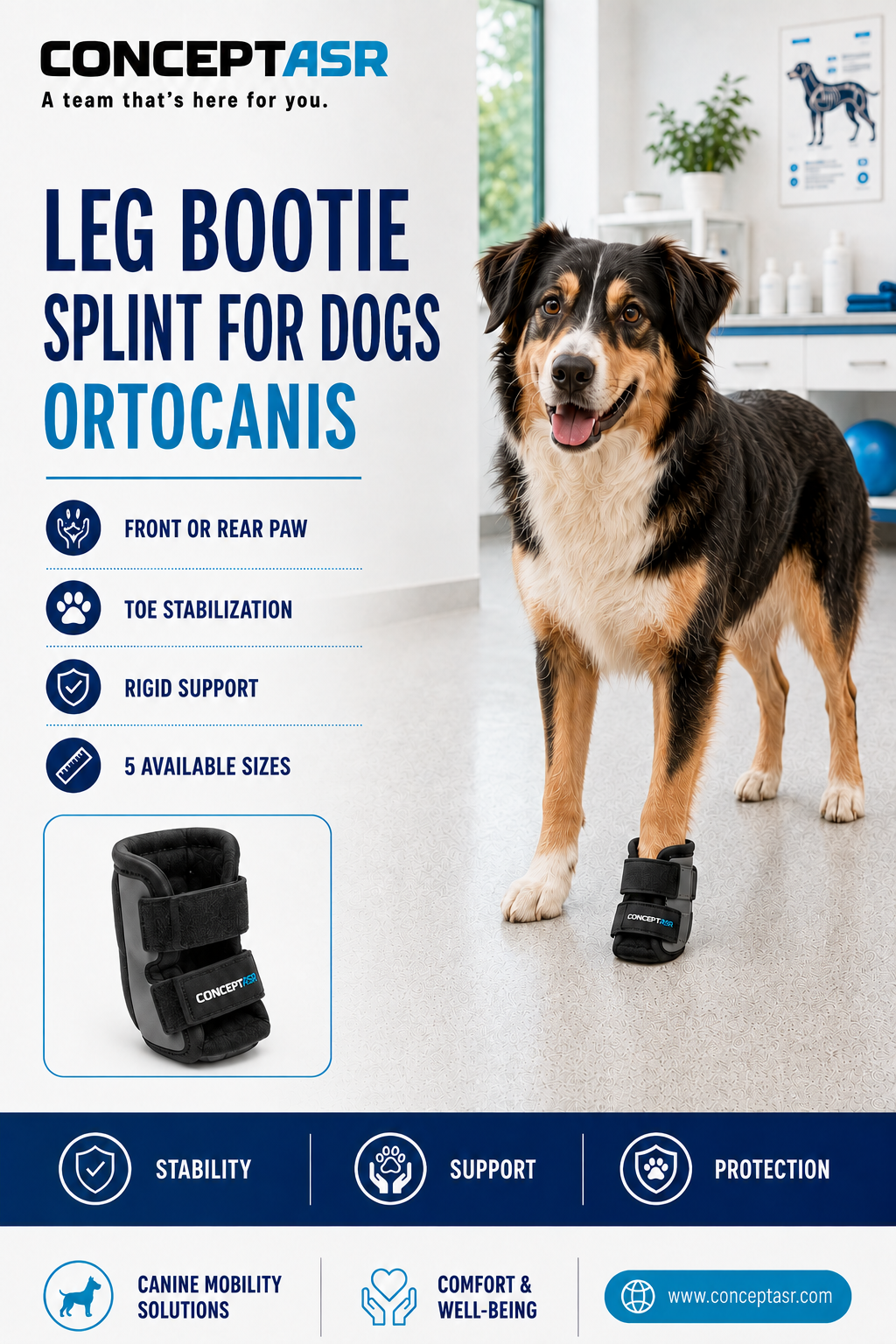
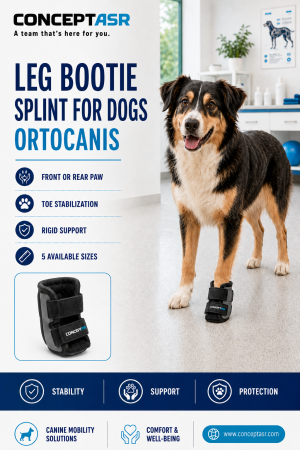
The Leg Bootie Splint for Dogs provides rigid support for the lowest portion of a dog’s front or rear limb. Its boot-shaped structure extends underneath the paw to stabilize the toes and help maintain the lower limb in an appropriate position.
Designed by Ortocanis, this short orthopedic splint can be used on either the right or left leg. It is sold individually and is available in five sizes for dogs weighing approximately 4 to 55 kg.
Support for the Paw and Toes
Unlike a carpal splint that leaves the paw completely free, the Leg Bootie Splint for Dogs extends underneath the paw. This design supports the lower part of the limb while also helping to stabilize the toes.
The splint may be suitable for dogs requiring structured support following certain injuries affecting the paw, toes, metatarsal area or lower limb. It may also be considered for dogs experiencing neurological or proprioceptive difficulties affecting the positioning of the paw.
Because it is shorter than a full front-leg or rear-leg splint, it concentrates its support on the distal portion of the limb rather than extending higher along the leg.
Suitable for a Front or Rear Paw
The Ortocanis bootie splint can be fitted on a front or rear paw. It can also be used on the right or left side, eliminating the need to select a side when ordering.
Its rigid structure helps maintain the lower limb and paw in a supported position. Adjustable hook-and-loop closures make the splint easier to install, remove and inspect than a traditional immobilizing bandage.
The product is sold individually. If support is required for more than one paw, order the appropriate quantity after consulting the veterinary professional responsible for the dog’s care.
Possible Applications
A veterinarian or qualified canine rehabilitation professional may recommend this type of splint in situations involving:
- Injuries affecting the toes or phalanges
- Metatarsal or metacarpal problems
- Certain injuries involving the lower portion of a limb
- Paw-positioning difficulties
- Knuckling or dragging of the paw
- Certain neurological conditions
- Proprioceptive deficits involving the distal limb
- Temporary support during a supervised recovery program
The suitability of the splint will depend on the dog’s diagnosis, anatomy, condition and rehabilitation objectives. It should not be selected solely from a list of symptoms.
Five Available Sizes
The Leg Bootie Splint for Dogs is available in the following sizes:
- XS: 14 cm long and 4.4 cm wide — approximately 4 to 11 kg
- Small: 16.5 cm long and 5.7 cm wide — approximately 11 to 18 kg
- Medium: 20.3 cm long and 6.4 cm wide — approximately 18 to 30 kg
- Large: 22.5 cm long and 7 cm wide — approximately 30 to 39 kg
- Extra Large: 27.9 cm long and 7.6 cm wide — approximately 39 to 55 kg
The stated weight ranges are approximate. The dog’s measurements and limb proportions are more important than its breed or weight alone.
Measure the dog carefully with a flexible measuring tape and compare the results with the product dimensions. Measurements should preferably be taken while the dog is standing naturally.
If the dog falls between two sizes, Ortocanis recommends selecting the larger size.
Selecting the Appropriate Splint
This model is specifically designed to support the lower portion of the limb and extend underneath the paw. It should not be confused with the Ortocanis carpal splint, which immobilizes the carpus while leaving the paw pads in contact with the floor.
It is also different from a full-leg splint, which extends farther up the front or rear limb. The correct model depends on the anatomical area requiring support.
Before ordering, confirm whether the dog requires support limited to the paw and distal limb or whether immobilization must extend above the carpus or hock.
ConceptASR Vet can help you review the measurements and available models, but the medical recommendation should come from a veterinarian.
Gradual Introduction and Fit Verification
Introduce the splint gradually unless a veterinary professional provides different instructions. Begin with short supervised periods to allow the dog to become accustomed to the product and to verify its position.
Regularly inspect the skin, paw and toes for redness, rubbing, swelling, pressure marks or irritation. Make sure the closures are secure without restricting circulation.
If the dog’s limb is slightly too narrow inside the selected splint, a veterinary professional may recommend using a cohesive bandage to increase the limb’s thickness and improve the fit. Do not add padding or modify the fitting method without appropriate guidance.
Remove the splint and consult a veterinary professional if the dog displays persistent discomfort, increased limping, unusual behaviour or skin irritation.
Cleaning and Daily Monitoring
Keep the interior of the splint clean and dry. Remove accumulated dirt, hair and moisture according to the manufacturer’s care instructions.
The dog should remain supervised while wearing the splint, particularly during the initial adaptation period. Inspect both the product and the animal’s skin every time the splint is removed.
Veterinary Guidance Recommended
The Leg Bootie Splint for Dogs is an orthopedic support product and does not replace veterinary diagnosis, treatment, surgery or rehabilitation follow-up.
Consult a veterinarian if your dog has suffered an injury, cannot bear weight, drags a paw, walks on the top of the toes or shows signs of pain, swelling or reduced mobility.
A veterinarian or qualified canine rehabilitation professional can determine whether this short bootie splint is appropriate and provide guidance concerning fitting, duration of use and permitted activity.
ConceptASR Vet offers personalized assistance in English and French for customers requiring help with product measurements and size selection.
Reviews
There are no reviews yet.