
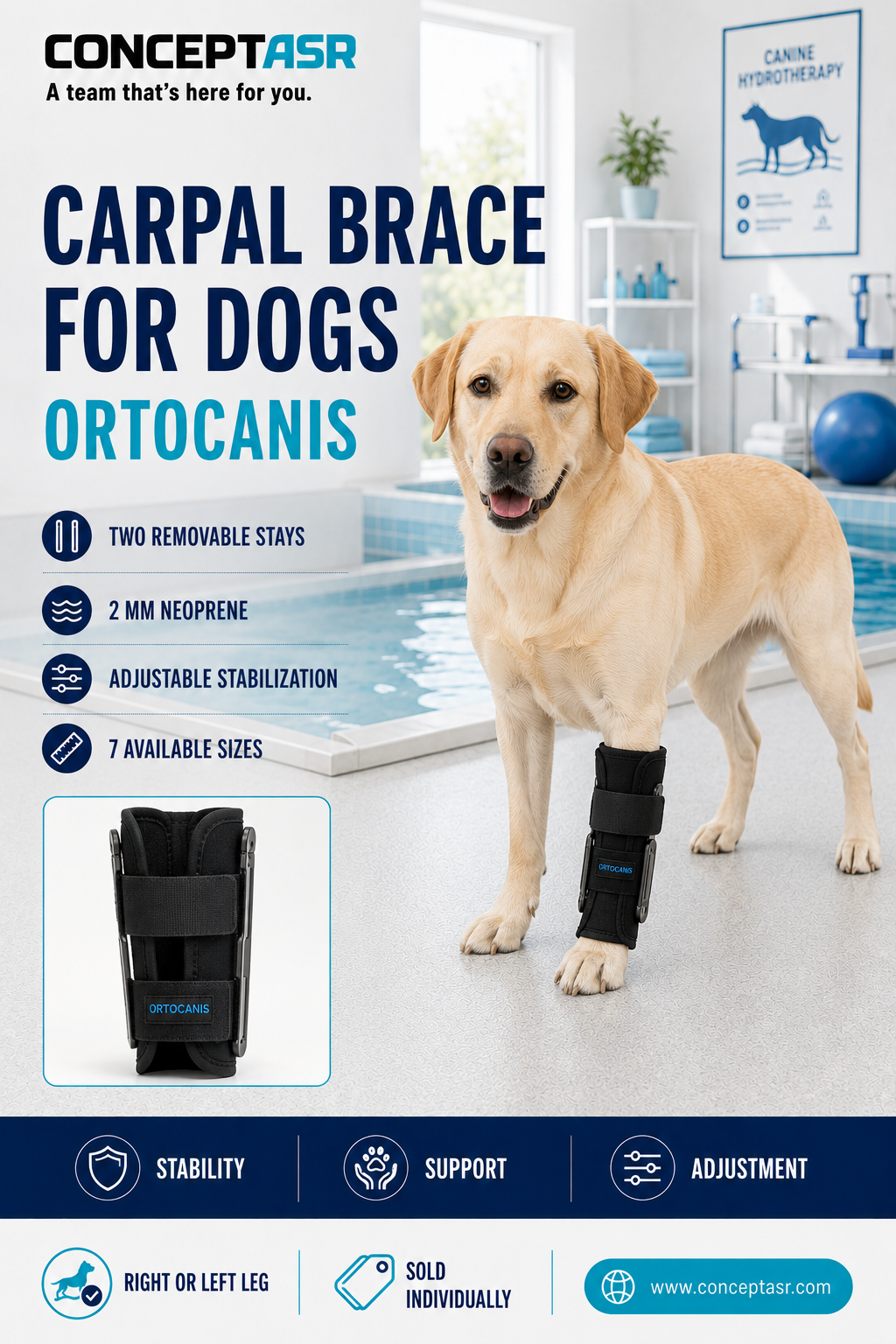
Adjustable stabilization for the canine wrist
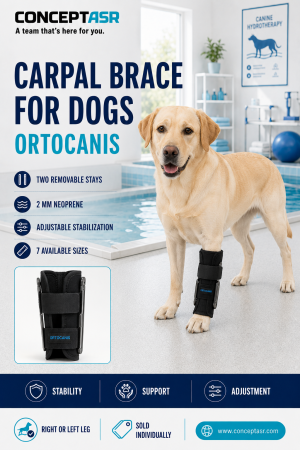
The Carpal Brace for Dogs by Ortocanis is a structured neoprene orthosis designed to support and stabilize the carpal joint, or wrist, of one front leg. Its two removable rigid stays allow the level of stabilization to be adapted according to the dog’s condition and the recommendations of its veterinarian or rehabilitation professional.
This brace provides more support than the flexible Ortocanis Carpal Wrap while remaining less restrictive than a rigid Carpal Splint or Front Leg Splint.
It is manufactured from 2 mm neoprene and can be used on either the dog’s right or left front leg. The brace is sold individually.
Two removable rigid stays
The Carpal Brace includes two rigid lateral stays positioned along the sides of the wrist. These reinforcements help limit excessive carpal movement and provide additional support to the joint.
The stays can be removed when a lower level of stabilization is appropriate. This allows the orthosis to offer different degrees of support during a supervised rehabilitation program.
According to Ortocanis, the brace can provide support ranging approximately from level 1 to level 3 on a scale where level 4 represents complete immobilization. The actual level depends on whether the stays are installed and how the brace is adjusted.
Changes to the configuration should follow professional guidance. Do not remove or reinstall the stays solely because the dog appears uncomfortable without first checking the size and fit.
Resistant 2 mm neoprene
The main body is made from 2 mm thick neoprene. This flexible material adapts around the dog’s wrist and provides homogeneous compression across the supported area.
The hook-and-loop closures are designed to remain secure while minimizing interference with the dog’s fur.
Additional protection inside the brace helps protect the extensor tendons along the front of the carpal area.
The neoprene must be applied evenly. Pressure concentrated beneath one strap or edge may create irritation or restrict circulation.
When may a carpal brace be considered?
With veterinary guidance, the Ortocanis Carpal Brace may be considered in situations involving:
- Carpal instability
- Carpal hyperextension
- Carpal osteoarthritis
- Certain tendon injuries
- Certain ligament injuries
- Supervised post-operative recovery
- Conservative management when surgery is not appropriate
- Temporary support during rehabilitation
- A need for greater stabilization than a flexible wrap
- Progressive adjustment of wrist support
The brace does not diagnose or treat the underlying cause of weakness, pain or lameness. A veterinarian should evaluate persistent symptoms, swelling or any sudden change in the dog’s gait.
Understanding the Ortocanis carpal supports
Ortocanis offers several products for different degrees of support:
- The Carpal Wrap provides flexible support without rigid stays.
- The Carpal Brace includes two removable stays for adjustable stabilization.
- The Carpal Splint provides a rigid block of the wrist while leaving the paw and toes in contact with the floor.
- The Front Leg Splint extends beneath the paw to stabilize the wrist, paw and toes.
The best choice depends on the location and severity of the dog’s condition. A more rigid product is not automatically better and may be inappropriate for some dogs.
How to measure the carpus
Use a flexible measuring tape to measure the complete circumference of the front leg at the height of the carpus. The carpus is located immediately above the front paw.
Take the measurement while the dog is standing naturally. Do not pull the measuring tape tightly into the fur or skin.
Available sizes:
- XS: circumference from 0 to 6 cm — brace length 8 cm
- S: circumference from 6 to 8 cm — brace length 9.5 cm
- M: circumference from 8 to 10 cm — brace length 10 cm
- L: circumference from 10 to 12.5 cm — brace length 14 cm
- XL: circumference from 12.5 to 15 cm — brace length 15.5 cm
- XXL: circumference from 15 to 19 cm — brace length 16.5 cm
- XXXL: circumference from 19 to 23 cm — brace length 17 cm
If the measurement falls between two sizes, Ortocanis recommends selecting the larger size.
The circumference must remain the principal selection criterion. Breed and body weight provide only approximate guidance.
How to put on the brace
Separate the hook-and-loop straps before placing the brace. Position the orthosis around the front leg immediately above the paw, at the height of the carpal joint.
The internal tendon protection should be positioned along the front portion of the leg. Verify that the rigid stays remain aligned along the sides of the wrist.
Gently stretch the neoprene around the leg so the pressure is distributed evenly. Fasten each strap gradually rather than tightening one strap completely before the others.
The brace should remain securely positioned without:
- Compressing the paw
- Restricting circulation
- Folding against the skin
- Interfering with the opposite leg
- Preventing the paw from contacting the floor
- Rotating around the wrist
Allow the dog to take several supervised steps on a level, non-slip surface after every adjustment.
Skin and circulation monitoring
Ortocanis recommends checking the dog’s skin approximately every two hours during the first few days of use.
Remove the brace and inspect the wrist, paw and areas beneath the straps. Watch for:
- Persistent redness
- Skin irritation
- Swelling
- Moisture or sweating
- Pressure marks
- Hair pulling
- A cold paw
- Excessive warmth
- Increased discomfort
If the paw begins to sweat shortly after the brace is installed, loosen the support to reduce the pressure.
The brace should always be placed on clean, completely dry skin and fur.
Gradual introduction
Begin with short supervised sessions. Allow the dog to become accustomed to the neoprene and rigid stays gradually.
The duration of use and the decision to use one, both or neither of the removable stays should follow the recommendations of the veterinarian or rehabilitation professional.
Do not leave the dog unattended while wearing the brace during the initial adaptation period.
Key benefits
- Supports one canine wrist
- Two removable rigid stays
- Adjustable degree of stabilization
- 2 mm neoprene construction
- Internal extensor tendon protection
- Hook-and-loop closures
- Suitable for the right or left front leg
- Seven available sizes
- Sold individually
- More structured than a flexible carpal wrap
Reviews
There are no reviews yet.