
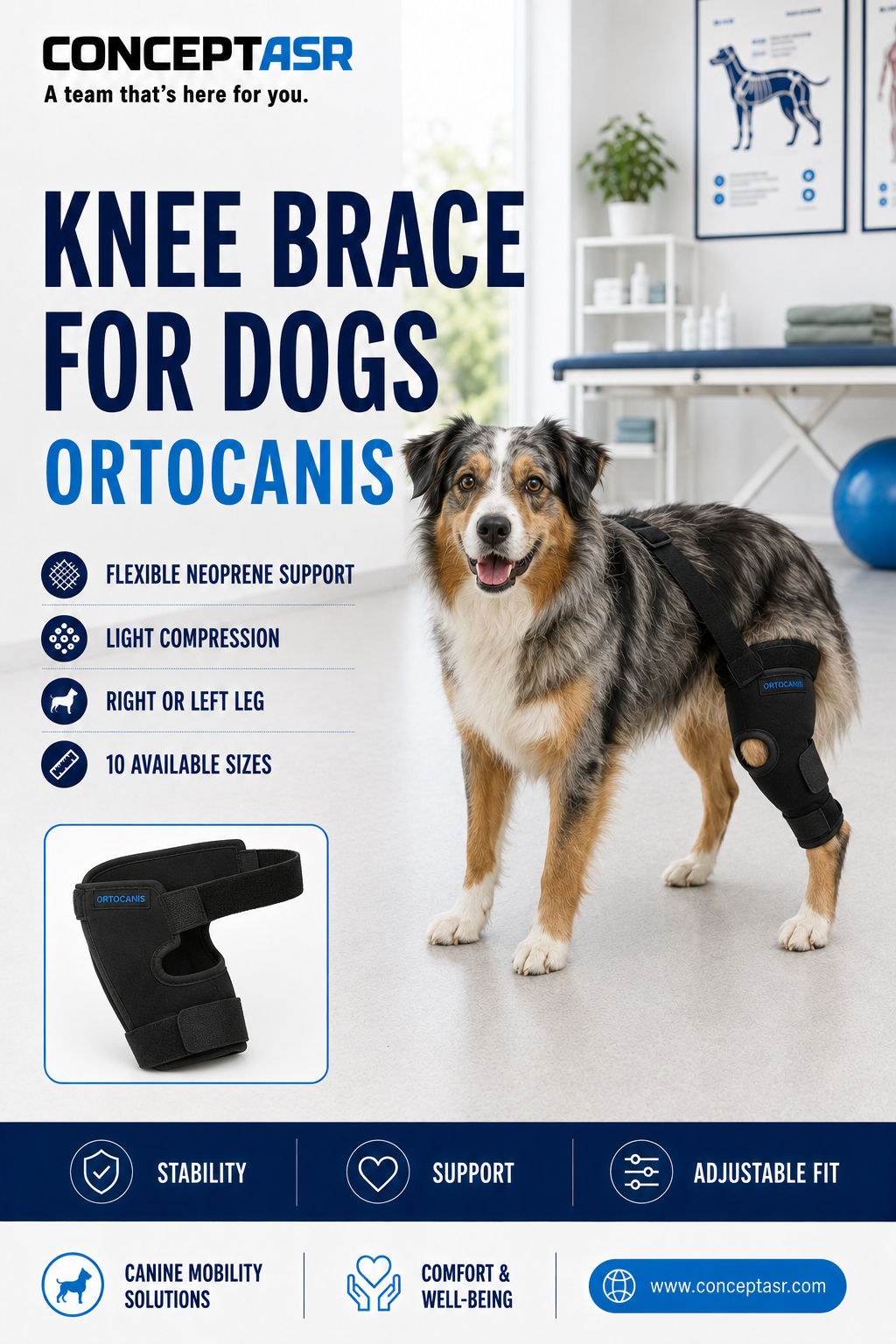
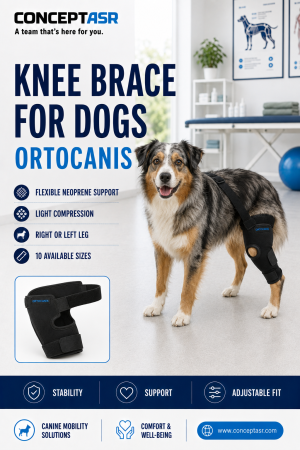
The Knee Brace for Dogs from Ortocanis provides flexible support, light compression and warmth around a dog’s stifle joint. Made from high-dynamic-resistance neoprene, the brace conforms around the rear leg while an adjustable upper strap helps maintain its position during use.
This model offers flexible support and should not be confused with the more rigid Ortocanis knee immobilizer containing lateral aluminium splints.
The Knee Brace for Dogs is available in separate right-leg and left-leg models and ten sizes. It is sold individually.
Flexible Support for the Stifle Joint
The canine knee, also called the stifle, is a complex joint that plays an important role in stability, movement and weight-bearing.
Trauma, sudden movement, strenuous activity, aging and joint degeneration may affect the dog’s comfort and mobility.
The Ortocanis brace wraps the joint in resistant, flexible neoprene. Its gentle compression and stabilizing effect can provide additional external support during activities authorized by the treating veterinarian.
The product does not completely immobilize the knee. Dogs requiring greater restriction or rigid lateral stabilization may need a different Ortocanis product, such as the knee immobilizer.
High-Resistance Neoprene
The brace is made from flexible ARD neoprene designed to adapt to the shape of the canine knee.
Neoprene provides light compression and retains warmth around the covered area. Its flexibility allows the joint to move while receiving external support.
The brace should fit closely without restricting circulation, pinching the skin or forcing the joint into an unnatural position.
Possible Applications
A veterinarian may recommend a flexible knee brace as part of a management or rehabilitation plan involving:
- Knee or stifle instability
- Osteoarthritis
- Certain cruciate ligament injuries
- Patellar luxation
- Age-related joint sensitivity
- Temporary support before a procedure
- Supervised use following a procedure
- Conservative veterinary management
- Canine rehabilitation exercises
- Additional stability during authorized activity
The presence of one of these conditions does not automatically mean that this brace is appropriate. A veterinarian should evaluate the dog and determine the required level of support.
Ten Available Sizes
Measure the circumference of the upper thigh at groin level using a flexible measuring tape.
The dog should be standing naturally whenever possible. Keep the measuring tape in contact with the coat without pulling it excessively tight.
Available sizes:
- XMini: thigh circumference from 13 to 14 cm
Approximate reference: Miniature Yorkshire Terrier around 2 kg - Mini: thigh circumference from 15 to 16 cm
Approximate breed reference: Miniature Pinscher - XXXS: thigh circumference from 17 to 18 cm
Approximate breed reference: Chihuahua - XXS: thigh circumference from 19 to 21 cm
Approximate breed reference: Jack Russell Terrier - XS: thigh circumference from 22 to 24 cm
Approximate references: Sheltie, Cocker Spaniel or Fox Terrier - Small: thigh circumference from 25 to 28 cm
Approximate references: Kelpie, Greyhound or Beagle - Medium: thigh circumference from 29 to 31 cm
Approximate references: Border Collie, Springer Spaniel or small Labrador Retriever - Large: thigh circumference from 32 to 36 cm
Approximate references: German Shepherd, small Rottweiler, Boxer or large Labrador Retriever - Extra Large: thigh circumference from 37 to 41 cm
Approximate breed reference: Rottweiler - XXL: thigh circumference from 42 to 47 cm
Approximate breed reference: Bernese Mountain Dog
Breed examples are approximate and should never replace measuring.
If the dog falls between two sizes, Ortocanis recommends selecting the smaller size for this flexible model.
Choosing the Correct Side
Select either the right-leg or left-leg model.
To identify the correct side, stand behind the dog and face in the same direction as the animal. The leg on your right is the dog’s right leg; the leg on your left is the dog’s left leg.
Confirm the side carefully before ordering. The anatomical construction of the brace means the right and left models are not interchangeable.
How to Fit the Brace
Gently slide the brace upward along the rear leg until the main section completely covers the knee.
Do not twist the brace or force the joint. The opening and shaped neoprene panels should align naturally with the stifle.
Route the fastening strap underneath the abdomen and over the back, then secure the hook-and-loop closure on the outside.
The strap should help maintain the brace without restricting breathing or creating excessive pressure around the abdomen.
Check that:
- The knee is properly covered
- The neoprene lies flat
- The brace does not rotate
- The strap is not twisted
- No skin or fur is pinched
- The dog can stand and walk comfortably
Optional Fastening Belt
Some dogs, particularly those with a sloping or lowered hip structure, may experience backward movement of the upper strap.
Ortocanis offers an optional knee-brace fastening belt for dogs requiring additional help keeping the brace in position.
The fastening belt is sold separately and is not included with the knee brace.
Gradual Introduction and Monitoring
Introduce the brace gradually through short supervised periods.
Observe the dog while it stands, walks, sits and lies down. Recheck the brace after several minutes of movement to ensure it remains correctly positioned.
Remove the product following each initial session and inspect the skin around the thigh, groin, knee and areas beneath the strap.
Discontinue use and consult a veterinarian or rehabilitation professional if swelling, persistent redness, rubbing or unusual discomfort appears.
Veterinary Guidance Recommended
The Knee Brace for Dogs is an orthopedic support product. It does not replace veterinary diagnosis, medication, surgery or professional rehabilitation.
Consult a veterinarian if your dog has persistent limping, swelling, knee pain, difficulty bearing weight or sudden changes in mobility.
A professional can determine whether flexible neoprene support provides the appropriate level of stability and establish the recommended wearing schedule and permitted activity.
ConceptASR Vet offers assistance in English and French to help customers review the thigh measurement, size and correct side before ordering.
This product is generally prepared and shipped on order. The applicable preparation time will be confirmed following purchase.
Reviews
There are no reviews yet.