
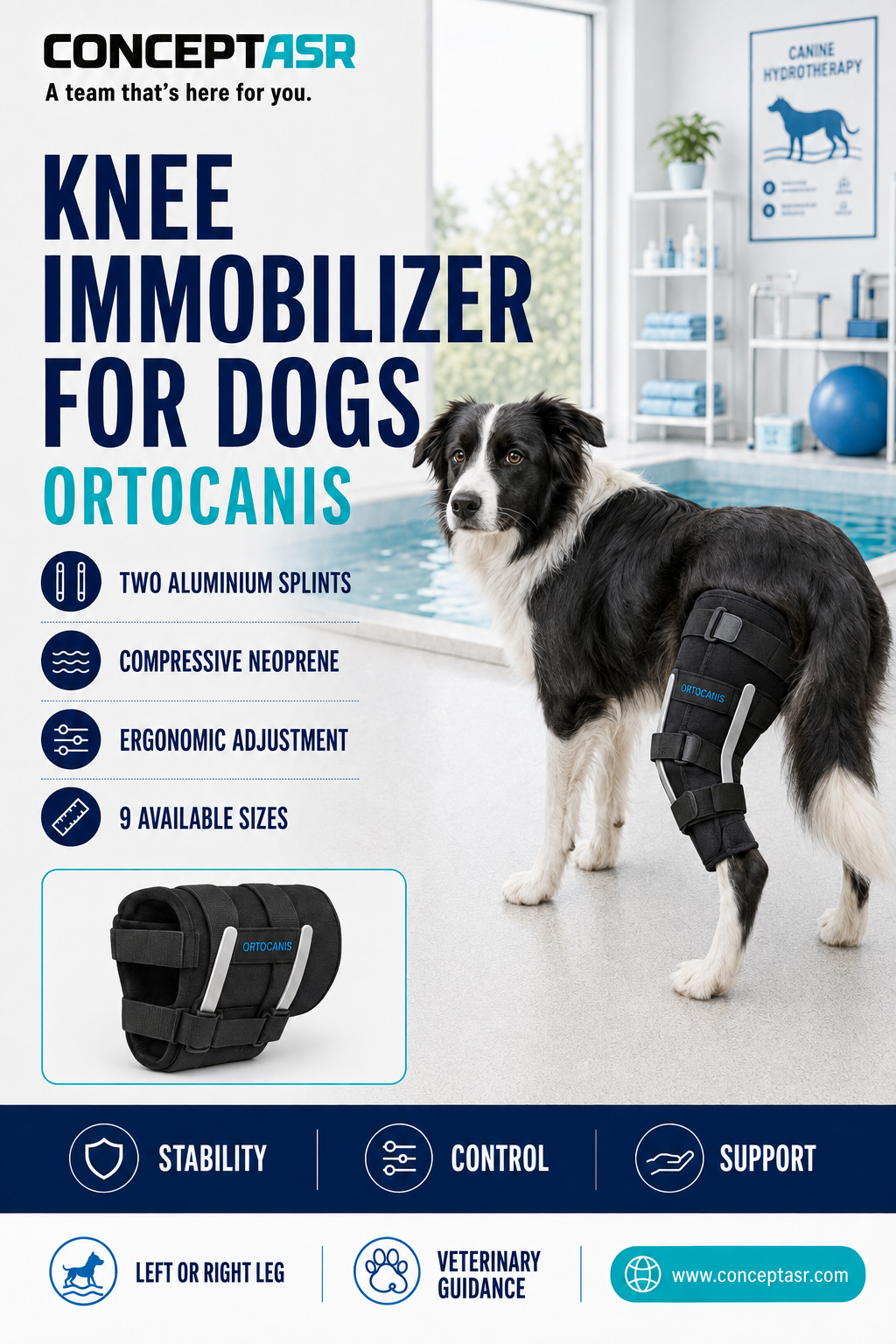
Reinforced stabilization of the canine knee
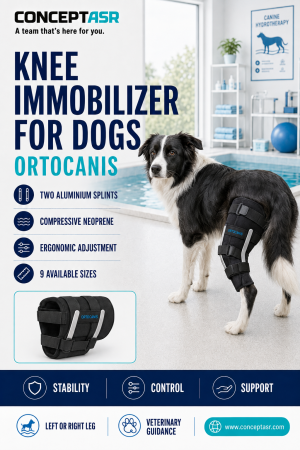
The Knee Immobilizer for Dogs by Ortocanis is a reinforced orthopedic support designed to provide partial immobilization and increased stability around the canine stifle joint. Its ergonomic neoprene construction incorporates two anatomically angled aluminium splints positioned on the inner and outer sides of the knee.
Unlike a flexible knee sleeve, this model limits a greater portion of the joint’s movement. It should therefore be selected and used with guidance from a veterinarian or qualified canine rehabilitation professional.
The immobilizer is available for either the left or right rear leg and is offered in nine sizes according to the circumference of the upper thigh.
Two lateral aluminium splints
The principal feature of the Knee Immobilizer is its pair of lateral aluminium splints. One is positioned on the inside of the leg and the other on the outside.
The splints are shaped at an angle to better follow the anatomy of the dog’s knee. Their position helps increase lateral stability and limits excessive movement of the joint.
The immobilizer is designed to provide partial rather than complete immobilization. The dog may still retain a controlled amount of movement depending on the fit, adjustment and recommendation of the treating professional.
The aluminium reinforcements must remain correctly positioned on either side of the knee. They should not press directly against a sensitive bony prominence or create a localized pressure point.
Compressive neoprene construction
The brace is made from special neoprene that provides compression and external support around the joint. Its flexible structure allows the immobilizer to adapt to the shape of the leg while the internal reinforcements add stability.
The adjustable straps help secure the product above and below the knee. Each strap should be fastened progressively so the brace remains stable without restricting circulation.
Excessive compression may create discomfort, swelling or skin irritation. Always check the dog’s leg and paw after fitting the immobilizer.
When may a knee immobilizer be considered?
With professional guidance, the Ortocanis Knee Immobilizer may be considered in situations involving:
- Patellar luxation
- Cranial cruciate ligament injuries
- Other knee ligament injuries
- Partial knee instability
- Certain pre-operative support requirements
- Certain post-operative rehabilitation protocols
- Situations requiring greater stability than a flexible knee brace
- Supervised recovery following a knee injury
- Controlled limitation of stifle movement
The product does not replace veterinary diagnosis, treatment or surgery when surgery is medically indicated.
The appropriate degree of immobilization depends on the injury, the dog’s anatomy and the stage of recovery. A veterinarian should determine whether this reinforced model is suitable for the individual dog.
Choosing the left or right leg
Select the side while standing behind the dog and looking in the same direction as the animal:
- A brace worn on the dog’s left rear leg requires the left model.
- A brace worn on the dog’s right rear leg requires the right model.
Do not determine the side while facing the dog, as this reverses the orientation.
How to measure the dog
Use a flexible sewing tape to measure the complete circumference of the upper thigh at groin level. Take the measurement while the dog is standing naturally whenever possible.
Do not pull the measuring tape tightly into the fur or skin. The tape should remain level around the thigh.
Available sizes:
- Mini: thigh circumference from 14 to 16 cm
- XXXS: thigh circumference from 17 to 19 cm
- XXS: thigh circumference from 20 to 22 cm
- XS: thigh circumference from 23 to 25 cm
- S: thigh circumference from 26 to 29 cm
- M: thigh circumference from 30 to 32 cm
- L: thigh circumference from 33 to 36 cm
- XL: thigh circumference from 37 to 42 cm
- XXL: thigh circumference from 43 to 48 cm
If the measurement falls between two sizes, Ortocanis recommends selecting the larger size for this immobilizer.
Breed examples are only approximate. Dogs of the same breed can have different proportions, so the thigh circumference must remain the primary sizing criterion.
How to put on the immobilizer
Open and loosen the lower adjustment straps before positioning the immobilizer. Do not force the dog’s joint or attempt to straighten the leg beyond its natural position.
Carefully slide the brace upward along the rear leg until the upper section reaches the groin. Position the knee area of the brace over the dog’s stifle joint.
Make sure the two aluminium splints remain positioned on the inner and outer sides of the knee. Fasten the straps gradually, beginning with a loose adjustment.
Confirm that the product remains stable without pinching the skin or restricting blood circulation. The dog should not display sudden pain or severe resistance during installation.
Allow the dog to take only a few supervised steps during the initial fitting. Observe the brace carefully to ensure it does not rotate, slide downward or pull excessively against the groin.
Monitoring during the first few days
The most sensitive areas should be checked frequently during the first several days of use. Remove the brace regularly and inspect the skin, fur, knee, upper thigh and lower leg.
Discontinue use and consult the treating professional if you observe:
- Persistent redness
- Skin rubbing or sores
- Swelling above or below the brace
- A cold or unusually warm paw
- Increased lameness
- Increased pain
- Excessive resistance to walking
- Rotation or displacement of the brace
A period of gradual adaptation may be required. The duration and frequency of use should follow the recommendations of the veterinarian or rehabilitation professional.
Additional stabilization
Some dogs have a sloping or lowered hip structure that can cause the upper portion of a knee brace to slide backward.
In these situations, the compatible Ortocanis fastening belt and chest harness may help maintain the immobilizer’s position. These accessories are sold separately.
Key benefits
- Provides reinforced knee support
- Two lateral aluminium splints
- Anatomically angled reinforcements
- Compressive neoprene construction
- Ergonomic design
- Adjustable fastening straps
- Nine available sizes
- Left and right leg models
- Designed for partial immobilization
- Suitable for veterinarian-supervised use
Reviews
There are no reviews yet.