
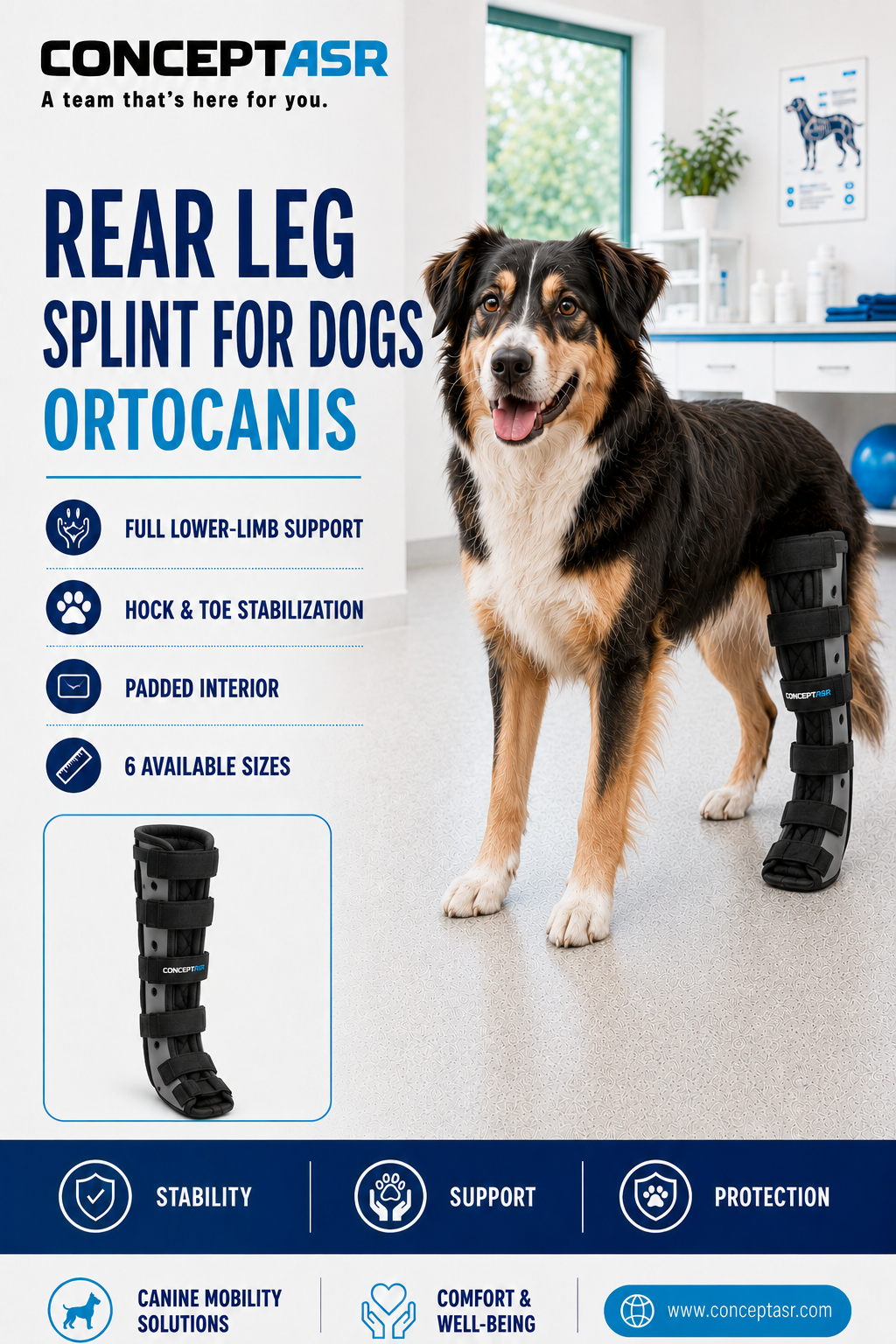
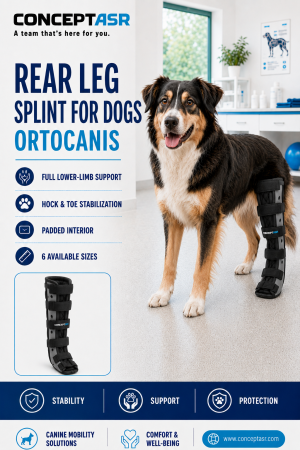
The Rear Leg Splint for Dogs provides rigid support for the lower portion of a dog’s hind limb, including the hock, foot and toes. Designed by Ortocanis, the splint extends from below the knee, follows the back of the leg and continues underneath the paw to stabilize the complete distal extremity.
This orthopedic splint is manufactured from thermodeformable polypropylene and lined with closed-cell foam. The rigid exterior helps maintain the supported limb in position, while the padded interior creates a more comfortable contact surface against the dog’s leg.
The same splint can be used on the right or left rear leg. It is sold individually and is available in six sizes, including an XXS model suitable for cats and certain very small dogs.
Complete Lower Hind-Limb Support
The hock, also called the tarsal joint, is located on the dog’s rear leg between the lower leg and paw. It plays an important role in standing, balance, movement and weight-bearing.
The Rear Leg Splint for Dogs supports this joint while also extending beneath the paw. Its shape helps stabilize the hock, foot and toes as one complete area.
This model is different from the shorter Ortocanis bootie splint, which concentrates its support around the paw and toes. The rear-leg splint extends significantly higher to support the complete lower hind limb.
Possible Applications
A veterinarian or qualified canine rehabilitation professional may recommend a rigid rear-leg splint in situations involving:
- Certain injuries affecting the lower rear limb
- Hock or tarsal instability
- Paw and toe injuries
- Conditions requiring temporary immobilization
- Neurological difficulties affecting limb positioning
- Knuckling or abnormal placement of the rear paw
- Certain traumatic injuries
- Temporary postoperative protection
- Veterinarian-supervised recovery
- Support during an animal rehabilitation program
The correct product depends on the location and nature of the dog’s condition. Veterinary assessment is recommended before choosing an orthopedic splint.
Rigid Polypropylene Construction
The splint is made from thermodeformable polypropylene, which provides structured external support.
Its interior is covered with closed-cell foam to create a padded layer between the dog’s limb and the rigid shell. Adjustable hook-and-loop closures help keep the product positioned on the leg and allow it to be removed for regular inspection.
Do not heat, reshape, cut or modify the splint unless instructed by a veterinarian or an experienced orthopedic professional.
How to Select the Size
Two measurements are provided for this product. Measurement A is used to select the size, while measurement B helps confirm the total height of the splint.
Take the measurements while the dog is standing naturally whenever possible. Use a flexible measuring tape and avoid estimating according to breed alone.
Measurement A
Measurement A begins at the hock. Continue down the back of the rear limb, underneath the paw and forward to the tip of the longest toe.
Available sizes are:
- XXS / Cat: measurement A of 11.5 cm — cats and dogs under approximately 4.5 kg
- XS: measurement A of 16.5 cm — approximately 4.5 to 11 kg
- Small: measurement A of 17.8 cm — approximately 11 to 18 kg
- Medium: measurement A of 20.03 cm — approximately 18 to 30 kg
- Large: measurement A of 24.1 cm — approximately 30 to 38 kg
- Extra Large: measurement A of 28.5 cm — approximately 38 to 55 kg
The weight ranges are approximate. The dog’s actual measurements should guide the final selection.
If your dog falls between two sizes, Ortocanis recommends choosing the larger size.
Measurement B
Measurement B corresponds to the total length of the splint. Place the flexible measuring tape underneath the paw at the longest toe. Continue along the back of the limb, over the hock and upward to just below the knee.
Approximate total lengths are:
- XXS / Cat: 16 cm
- XS: 24 cm
- Small: 25.5 cm
- Medium: 28 cm
- Large: 35.5 cm
- Extra Large: 40.5 cm
Use measurement A to select the size. Measurement B provides an additional reference for the overall height of the splint.
Suitable for the Right or Left Rear Leg
There is no separate right-side or left-side model. The same product can be positioned on either rear leg.
The splint is sold individually. If the dog requires support on both hind limbs, consult a veterinarian before ordering two products. Bilateral splinting may considerably affect the animal’s balance, gait and ability to move.
Gradual Introduction
Introduce the Rear Leg Splint for Dogs gradually unless the treating veterinarian provides different instructions.
Begin with short supervised sessions. Observe how the dog stands, places the paw and moves while wearing the product. The splint should remain aligned with the limb without rotating or sliding.
Remove it following each initial session and carefully inspect:
- The skin around the hock
- The paw and toes
- Areas underneath the closures
- The edges of the splint
- The interior foam lining
Watch for redness, pressure marks, rubbing, swelling, moisture or skin irritation. Discontinue use and consult a veterinary professional if persistent discomfort or irritation occurs.
Achieving an Appropriate Fit
The splint should fit securely without being excessively tight. The straps should maintain its position without restricting circulation or pinching the skin.
In certain cases, when the leg is slightly narrow inside the appropriate splint, a veterinarian may recommend adding a cohesive bandage to increase the thickness of the limb and improve the fit.
Do not compensate for an incorrect size by overtightening the closures or adding excessive padding.
Care and Daily Monitoring
Keep the splint and foam interior clean and dry. Remove accumulated dirt, hair and moisture according to the manufacturer’s instructions.
The dog should remain supervised while wearing the product, especially during the adaptation period. Follow the veterinarian’s recommendations regarding daily wearing time, removal periods and permitted activities.
Veterinary Guidance Recommended
The Rear Leg Splint for Dogs is an orthopedic support product. It does not replace veterinary diagnosis, treatment, surgery or professional rehabilitation.
Consult a veterinarian if your dog has sustained an injury, cannot bear weight on a rear leg, drags a paw, walks on the top of its toes or displays pain, swelling or reduced mobility.
A veterinarian or qualified canine rehabilitation professional can determine whether this splint is appropriate and provide instructions regarding sizing, fitting, wearing time and activity.
ConceptASR Vet offers personalized assistance in English and French to help customers review the measuring instructions and available sizes before ordering.
Reviews
There are no reviews yet.